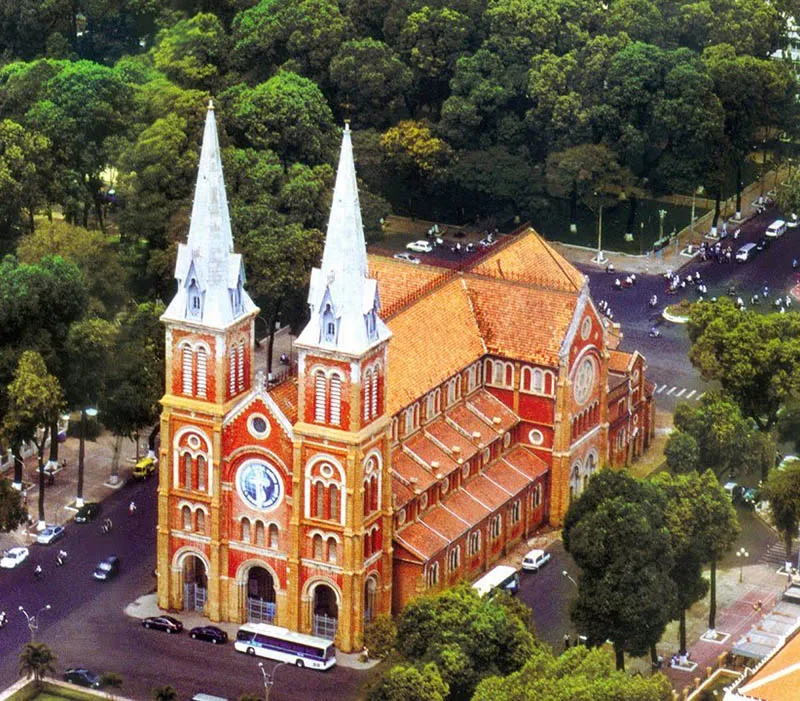
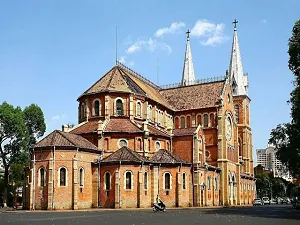
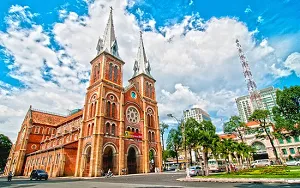
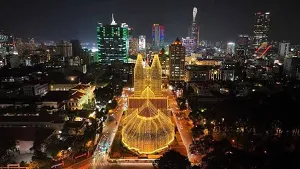
Duc Ba (Our Lady’s) Cathedral is located on Han Thuyen Street, facing down Dong Khoi Street, District 1, Ho Chi Minh City. It was inaugurated in 1880, and became the spiritual and cultural crucible of the French presence in the Orient.
After the first French colonizing force arrived in Vietnam in the mid - 19thcentury, it took only 21 years before the country had a cathedral to match the hulking Gothic edifices of France itself. The cathedral was supposed to represent the glory of the French Empire. Yet, as is always the case with colonization, this attempt to import French traditions into Vietnam transformed the colonizers' culture in the process. Even though the cathedral was built in a Western architectural style, it has a uniquely Eastern aspect.
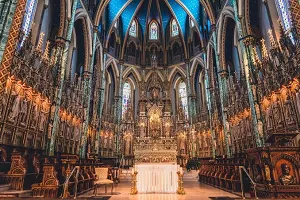
Several architects put forward design proposals for the cathedral, but in 1877 the authorities selected Mr Bourard, who was famed for his religious architecture. He envisaged, and executed, a basilica-like structure with a square plan. The cathedral is composed of two main central bays with two sidereal corridors, with tall pillars and light coming in through sets of high windows, and a semi-circular shrine. The style follows a Roman pattern, although the outside contains some modifications: the cathedral's vaults are Gothic, and a modern steel skeleton supports the whole building.